
Oracle DB
What is Oracle DB?
Oracle DB is a high-performance, scalable, and secure relational database management system designed for enterprise applications. It provides advanced features such as robust data security, comprehensive backup and recovery options, and powerful analytics capabilities. Organizations choose Oracle DB for its ability to handle large volumes of data, support complex transactions, and ensure high availability and reliability.
Why Connect Oracle DB to Monte Carlo?
Integrating Monte Carlo with Oracle DB allows you to monitor your data assets through custom SQL monitors, which can be created in either the UI wizard and/or programmatically via monitors as code (API/SDK too). These monitors can be used to generate notifications (incidents) to relevant stakeholders and circuit break pipelines.
After connecting Oracle here is what you can expect to see:
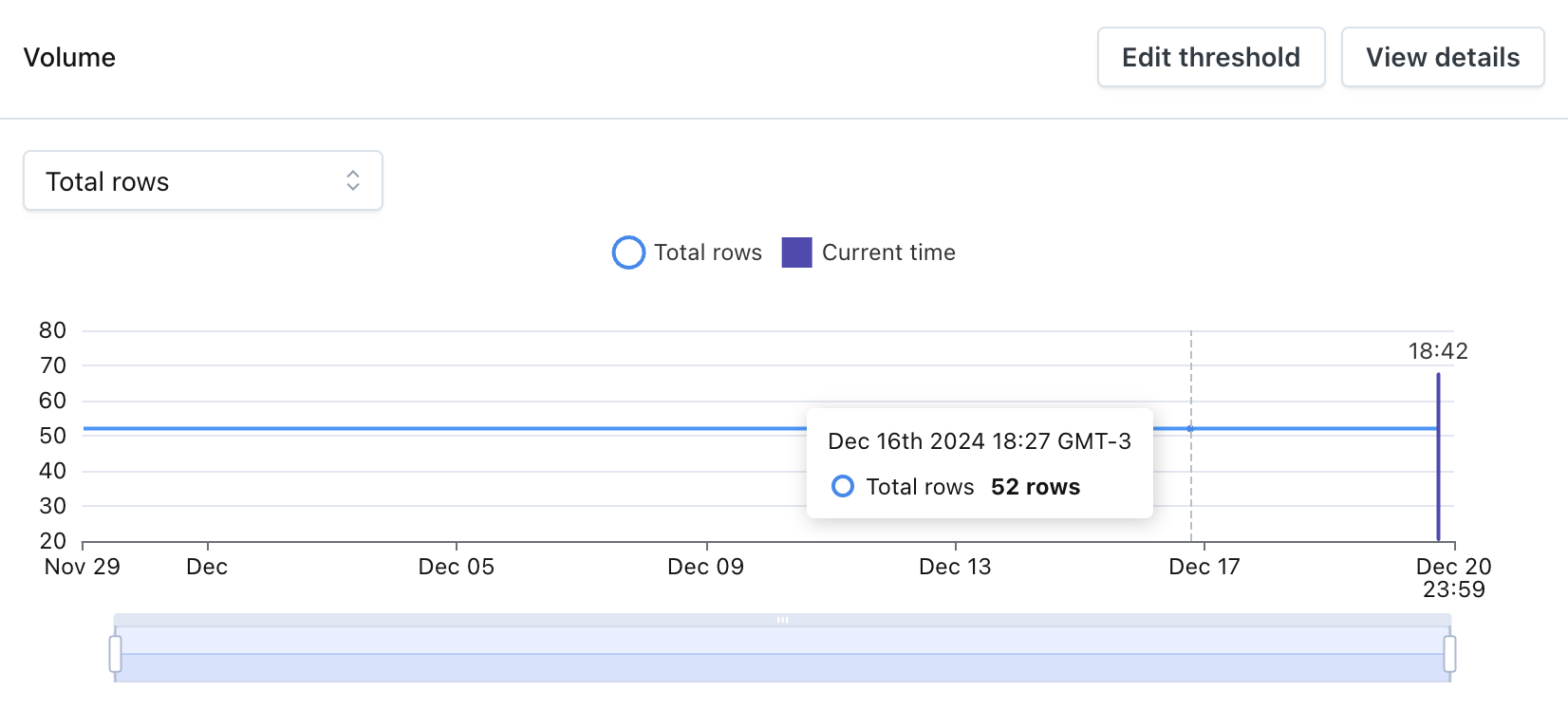
Volume:
Our volume monitors are active by default. By collecting metadata on your tables, Monte Carlo's machine learning algorithm can set automatic thresholds to alert when a table has gone too long without a change in size or when an abnormal amount of rows are added or deleted.
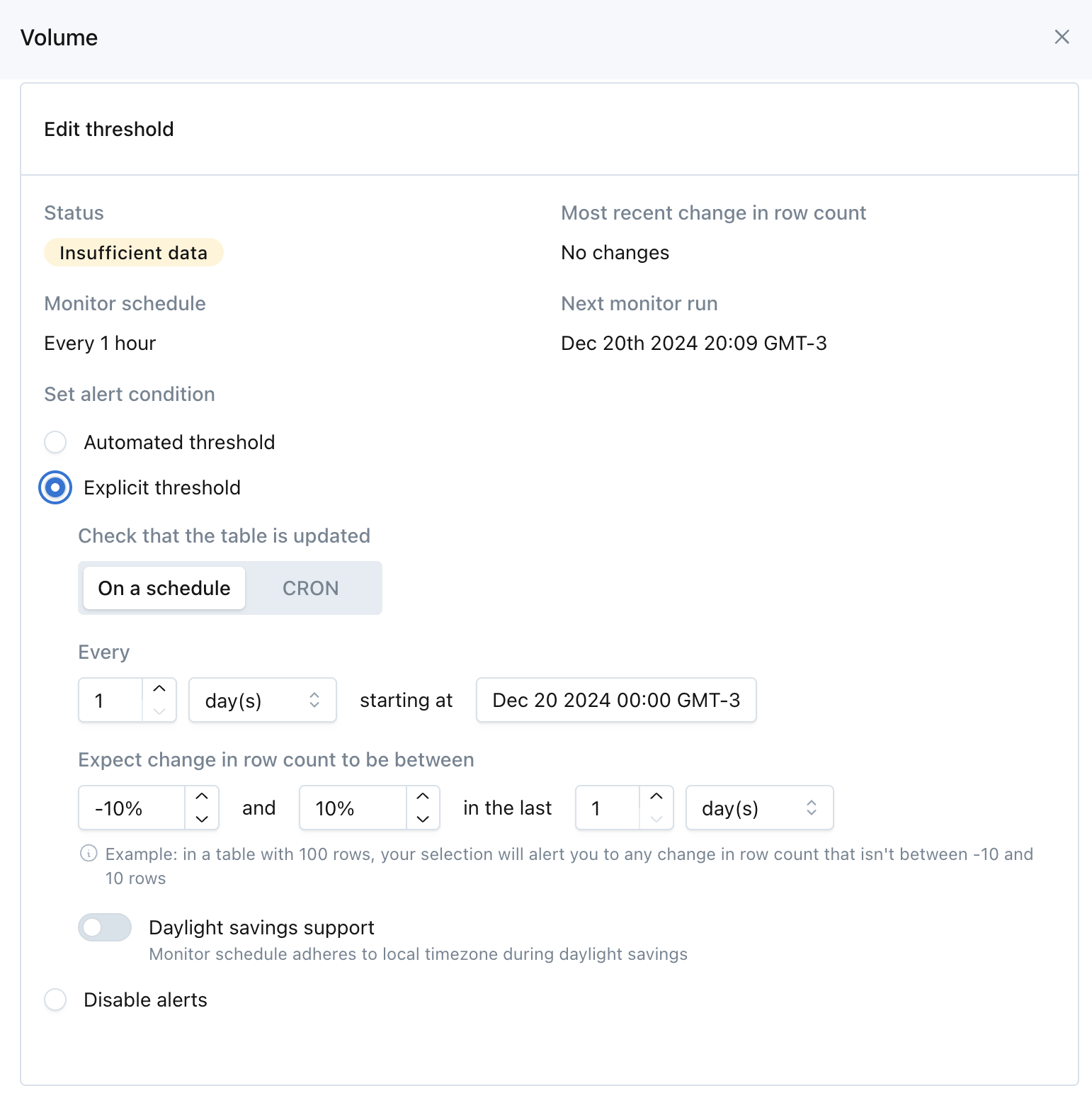
A user can choose to set the thresholds if they do not want to use the ones calculated by our machine learning algorithm, this is done by clicking the Edit threshold button.
Monitor & Lineage Support
Below are the monitors & lineage support for the Oracle Integration today. Please reach out to your Monte Carlo representative if you have requirements for additional monitors.
| Category | Monitor / Lineage Capabilities | Support |
|---|---|---|
| Table Monitor | Freshness | ✅ (via opt-in row count*) |
| Table Monitor | Volume | ✅ |
| Table Monitor | Schema Changes | ✅ |
| Metric Monitor | Metric | ✅ |
| Metric Monitor | Comparison | ✅ |
| Validation Monitor | Custom SQL | ✅ |
| Validation Monitor | Validation | ✅ |
| Job Monitor | Query performance | |
| Lineage | Lineage |
*freshness monitors are available via user opt-in for each table. These monitors would run count(*) queries for each table to detect freshness anomalies.
Connecting to Oracle DB
Now that we know the value connecting Oracle DB to Monte Carlo can bring, here are the necessary steps to set up the integration.
PrerequisitesTo create a service account, you will need admin credentials to your Oracle database.
This guide explains how to create a read-only service account for Monte Carlo in your Oracle DB. Once your service account is created, you can onboard the Oracle integration using the Monte Carlo UI.
If you require connecting to Oracle using SSL, you will need to use our CLI tool. After creating a service user, please see here for more instructions.
1. Create a read-only service account
Please run the SQL snippet below on your Oracle database to create a read-only service account for Monte Carlo
CREATE USER montecarlo IDENTIFIED BY '<PASSWORD>';
GRANT CREATE SESSION to montecarlo;

/*
Grant access to all tables and views. Repeat for all relevant tables (or schemas).
Select permissions are necessary to create assets and custom SQL monitors.
*/
GRANT SELECT ANY TABLE TO montecarlo;
-- or
GRANT SELECT ON <SCHEMA>.<TABLE> TO montecarlo;
-- ... repeating for each table.
-- or, only available in Oracle 23c+:
-- GRANT SELECT ON ANY TABLE ON SCHEMA <schema> TO 'montecarlo';
2a. Onboard Oracle Integration using Monte Carlo UI
With the service user created, you can add Oracle integration using our onboarding wizard.
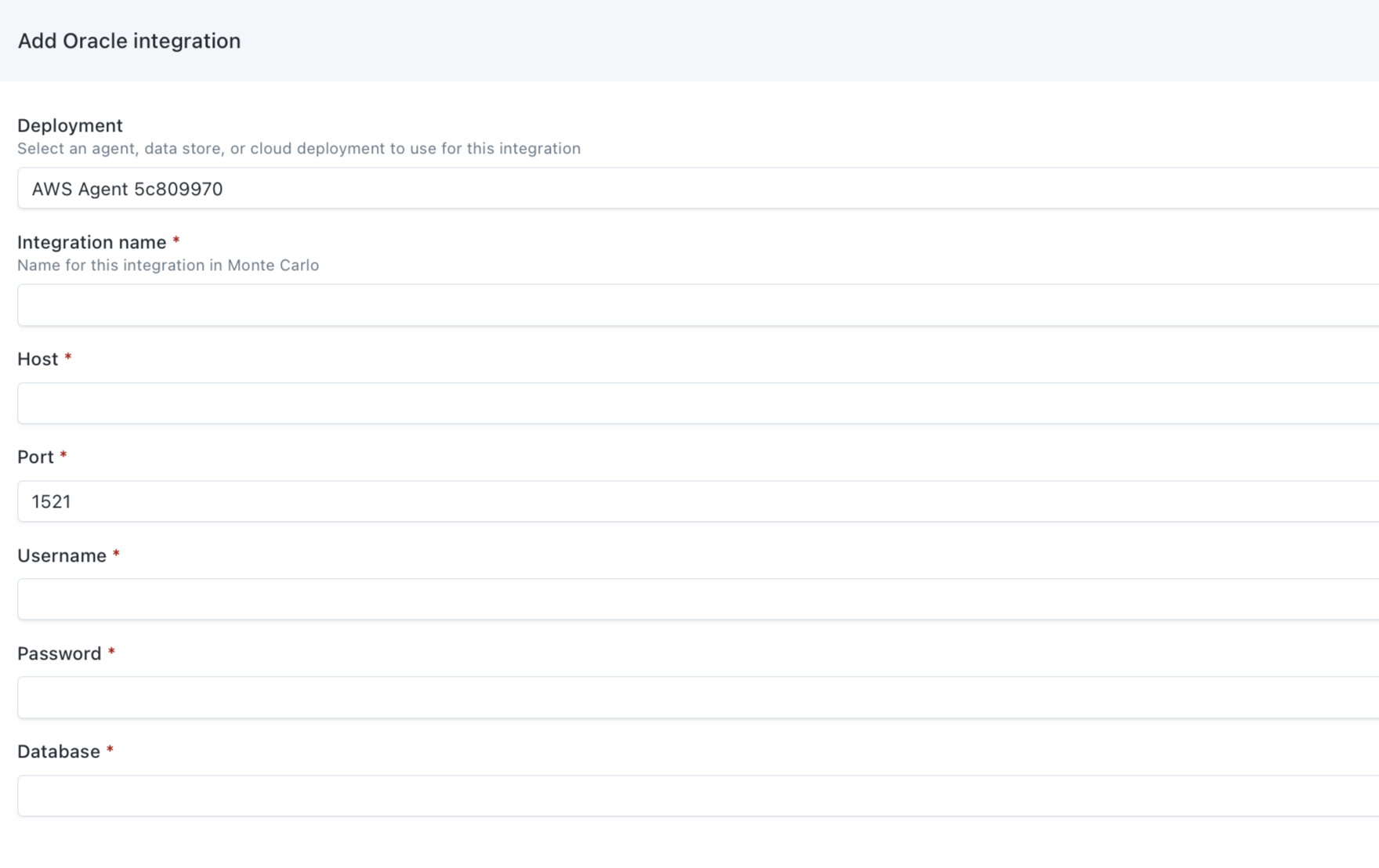
Deployment: [Optional] If you have multiple deployments already in your Monte Carlo account, choose the deployment you want to use for this integration. If you do not have multiple deployments, this field will not be shown.Integration name: The user-friendly name for this integration.Host: The host of the Oracle database, (e.g.oracledb.xxxxxxxxxx.us-east-2.rds.amazonaws.com)Port: The SQL port of the Oracle database, typically 1521.Username: The username of the service account you created in Step 1.Password: The password of the service account you created in Step 1.Database: The Oracle database name that Monte Carlo will monitor.
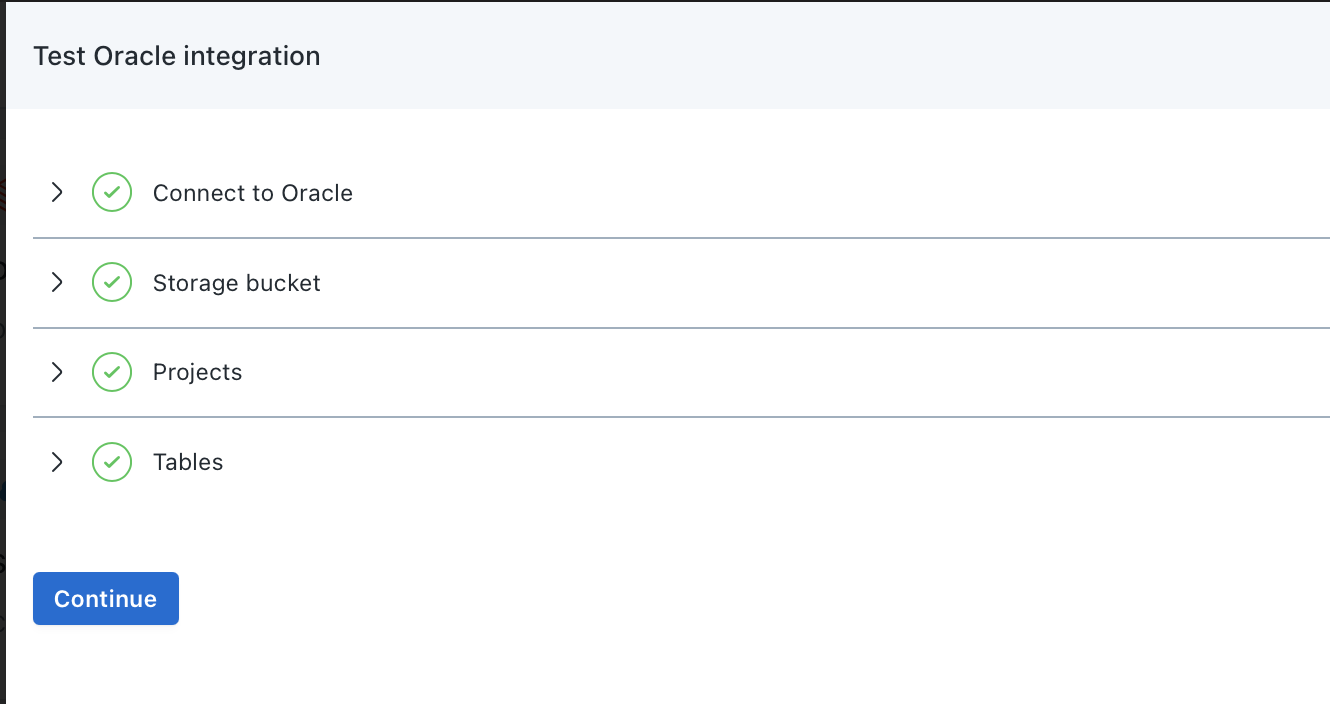
When you click Add, Monte Carlo will run a series of validations to ensure we are able to reach the Oracle database and have the permissions required to collect metadata. If validation failures will be surfaced so you can address them before trying again.
2b. Onboard Oracle Integration using SSL
PrerequisitesRequires creating a service account, as outlined here.
Monte Carlo supports SSL encrypted connections to Oracle databases, including:
- Server certificate verification (one-way SSL) - validates the Oracle server's identity using a CA certificate
SSL configuration is supported via the command-line interface (CLI) for both creating new connections and updating existing ones.
CLI Version RequirementOracle SSL support requires CLI version v0.147.0 or later.
You can find all available options for configuring an Oracle connection in the CLI documentation:
- add-oracle - Create a new Oracle connection with SSL
- update-oracle - Update an existing Oracle connection, including SSL configuration
Examples of SSL Authentication
- Server Authentication. To verify the identity of the Oracle server, use the add-oracle command specifying the CA certificate (
--ssl-ca). The CA certificate ensures that the server's identity is verified.
SSL Verification Options
Monte Carlo provides fine-grained control over SSL certificate verification:
| Option | Default | Description |
|---|---|---|
--ssl-verify-identity | Not set (backend default) | Verifies that the server's certificate hostname matches the connection target. Set to true to enable or false to disable. Requires --ssl-ca. |
--ssl-verify-cert | Not set (backend default) | Validates the server's certificate chain against the provided CA certificate. Set to true to enable or false to disable. Requires --ssl-cert. |
--skip-cert-verification | false | Skips ALL SSL verification (both certificate and hostname). Use only for testing - not recommended for production. |
Common scenarios:
- AWS RDS with hostname mismatch: Set
--ssl-verify-identity=falseif connecting via a custom endpoint or IP address - Self-signed certificates in development: Use
--skip-cert-verificationfor testing only - Standard production setup: Use defaults (verification enabled when certificates are provided)
Updating SSL Configuration
You can update SSL settings for an existing Oracle connection using the update-oracle command. This is useful when:
- Enabling SSL on a connection that was previously created without SSL
- Updating certificates (e.g., when certificates expire or are rotated)
- Changing SSL verification settings
- Disabling SSL on a connection
Important: Port RequirementsOracle uses different ports for SSL and non-SSL connections:
- Port 1521: Standard TCP port for non-SSL connections
- Port 2484: TCPS port for SSL/TLS encrypted connections
When updating SSL settings, you must also update the port accordingly:
- Enabling SSL: Use port
2484(or update from1521to2484)- Disabling SSL: Use port
1521(or update from2484to1521)
Examples:
Enable SSL on an existing connection:
montecarlo integrations update-oracle \
  --connection-id <connection-uuid> \
  --ssl-ca /path/to/ca.pem \
  --port 2484
Disable SSL (remember to update the port):
montecarlo integrations update-oracle \
  --connection-id <connection-uuid> \
  --ssl-disabled=true \
  --port 1521
Update only SSL verification settings (port remains the same):
montecarlo integrations update-oracle \
  --connection-id <connection-uuid> \
  --ssl-verify-identity=false
ImportantSSL is supported in both Oracle Thin mode (the default) and Thick mode. In Thin mode Monte Carlo configures SSL using an SSL context; in Thick mode it validates the server certificate against an Oracle wallet that the agent (or collector) builds automatically from your CA — no manual wallet setup is required. Thick-mode SSL requires a recent agent/collector version that includes Oracle thick-mode TLS support.
SSL Notes
- Thin & Thick: SSL works in both modes. Thin mode uses an SSL context; Thick mode builds an Oracle wallet automatically from your CA certificate. Thick-mode SSL requires a recent agent/collector version.
- One SSL CA per Thick agent: In Thick mode the Oracle client's TLS trust store is process-global, so a single agent supports one Oracle SSL CA. Two SSL Oracle connections with different CA certificates on the same Thick-mode agent are not supported — use a separate agent for each. (Thin mode has no such limit.)
- TLS Version: TLS 1.2 is recommended. TLS 1.3 support depends on your Oracle server configuration.
- Cipher Suites: Monte Carlo supports cipher suites at OpenSSL security level 1, including
SSL_RSA_WITH_AES_256_GCM_SHA384and other TLS 1.2 compatible ciphers. This ensures compatibility with Oracle and other enterprise deployments.
SSL Troubleshooting
SSL Handshake Failure
- Verify your Oracle server supports TLS 1.2
- For RDS, ensure the Option Group has
SQLNET.CIPHER_SUITEset to a GCM cipher suite (e.g.,SSL_RSA_WITH_AES_256_GCM_SHA384) - Verify the CA certificate matches the server's certificate chain
Connection Timeout on Port 2484
- Verify SSL is enabled on your Oracle instance
- Check security group/firewall rules allow port 2484
- For RDS, ensure the Option Group with SSL is applied and the instance was rebooted
Certificate Verification Failed
- Ensure you're using the correct CA certificate for your Oracle server
- For RDS, use the region-specific certificate bundle
FAQs
What is the minimum supported version?
Monte Carlo supports Oracle Database 12.1 and newer.
Are cloud variants of Oracle like AWS RDS supported?
Yes, AWS RDS for Oracle is supported, including SSL/TLS encrypted connections.
Is SSL supported?
Yes, Monte Carlo supports SSL connections to Oracle databases. See the Connect using SSL section for detailed configuration steps.
Is client certificate authentication (mTLS) supported?
No. For now we only support server certificate validation (one-way SSL) but if you are interested in mTLS, please reach out to us!
Does Monte Carlo support Oracle Thick mode?
Yes, when connecting through an agent. Oracle Thick mode loads the Oracle Client libraries and is required for some Oracle configurations that Thin mode cannot authenticate against — for example, accounts that only expose the legacy password verifier.
Thick mode is enabled with the MCD_ORACLE_THICK_MODE agent environment variable. See the "How do I set additional environment variables on the agent?" FAQ in the documentation for your agent deployment platform for how to set it. Thick mode must be enabled on an agent dedicated to Thick-mode Oracle. Thick mode supports SSL (the agent builds an Oracle wallet automatically from your CA), with one limitation: because the Oracle client's TLS trust store is process-global, a single Thick-mode agent supports one Oracle SSL CA — use a separate agent for each SSL integration that uses a different CA.
If you are not using an agent, contact Monte Carlo support to enable Thick mode.
What hosting solutions are supported?
This integration supports any instance that is reachable from one of our hosting options. Please see the networking docs for more detail.
Why does my table not have volume (row count) metrics?
If the table is partitioned, we do not collect row count metrics automatically.
Oracle does not maintain live row counts for partitioned tables. Instead, row count information is only available when partition-level statistics are collected via the DBMS_STATS package. These statistics represent a snapshot of the table at the time they were gathered and can quickly become outdated.
Monte Carlo does not use row count metrics based on manually collected statistics. This is because relying on outdated row counts can lead to inaccurate anomaly thresholds and an increased risk of false positives or missed incidents.
If you would like volume monitoring enabled for a specific partitioned table, you can enable the opt-in volume monitor which will run a select count(*) on the table hourly to collect volume data. You can optionally add a where condition to reduce the amount of rows scanned.
Why can't I select an Oracle table to trigger a monitor when the table is updated?
The When a table is updated trigger relies on the table's last-updated time, which Monte Carlo collects from warehouse metadata. Oracle doesn't expose a last-updated time in its metadata, so Monte Carlo doesn't collect freshness for Oracle tables out of the box, and Oracle tables aren't listed as trigger options. Opt-in freshness monitors for Oracle work by tracking row counts, so they don't add a last-updated time either. To run a monitor on an Oracle table regularly, use On a schedule instead.
How can I validate Monte Carlo has access to my assets?
After completing the Oracle integration setup, your Oracle assets should appear in the Monte Carlo Assets page between a few minutes and one hour. If you don't see your assets after this time period, you can run a validation test to troubleshoot the connection:
- Navigate to Settings → Integrations
- Find your Oracle integration and click on it
- Select the specific connection you want to test
- Click the Test button from the connection menu
This validation test will help identify any configuration issues that might be preventing your assets from appearing. When running the validation test, you should see all green checkmarks. If any errors are encountered, the system will provide specific steps to resolve them.
Are any schemas excluded from collection?
Yes. Monte Carlo automatically excludes the following system schemas from metadata collection:
- ANONYMOUS
- APPQOSSYS
- AUDSYS
- DBSFWUSER
- DBSNMP
- DIP
- GSADMIN_INTERNAL
- GSMCATUSER
- GSMUSER
- GGSYS
- OUTLN
- REMOTE_SCHEDULER_AGENT
- RDSADMIN
- SYS
- SYS$UFM
- SYSBACKUP
- SYSDG
- SYSKM
- SYSRAC
- SYSTEM
- XDB
- XS$NULL
- CTXSYS
Updated 26 days ago