
AWS: CloudFormation Deployment
How-to create and register an OpenTelemetry data store on AWS using CloudFormation
Prerequisites
- You are an admin in AWS.
- You have admin permissions in your data warehouse
- You are an Account Owner.
Steps
1. Deploy the Data Store
Monte Carlo provides a CloudFormation template to deploy an OpenTelemetry data store. You can download a copy of the template here. You can use the link below to deploy the deploy the stack to your AWS account.
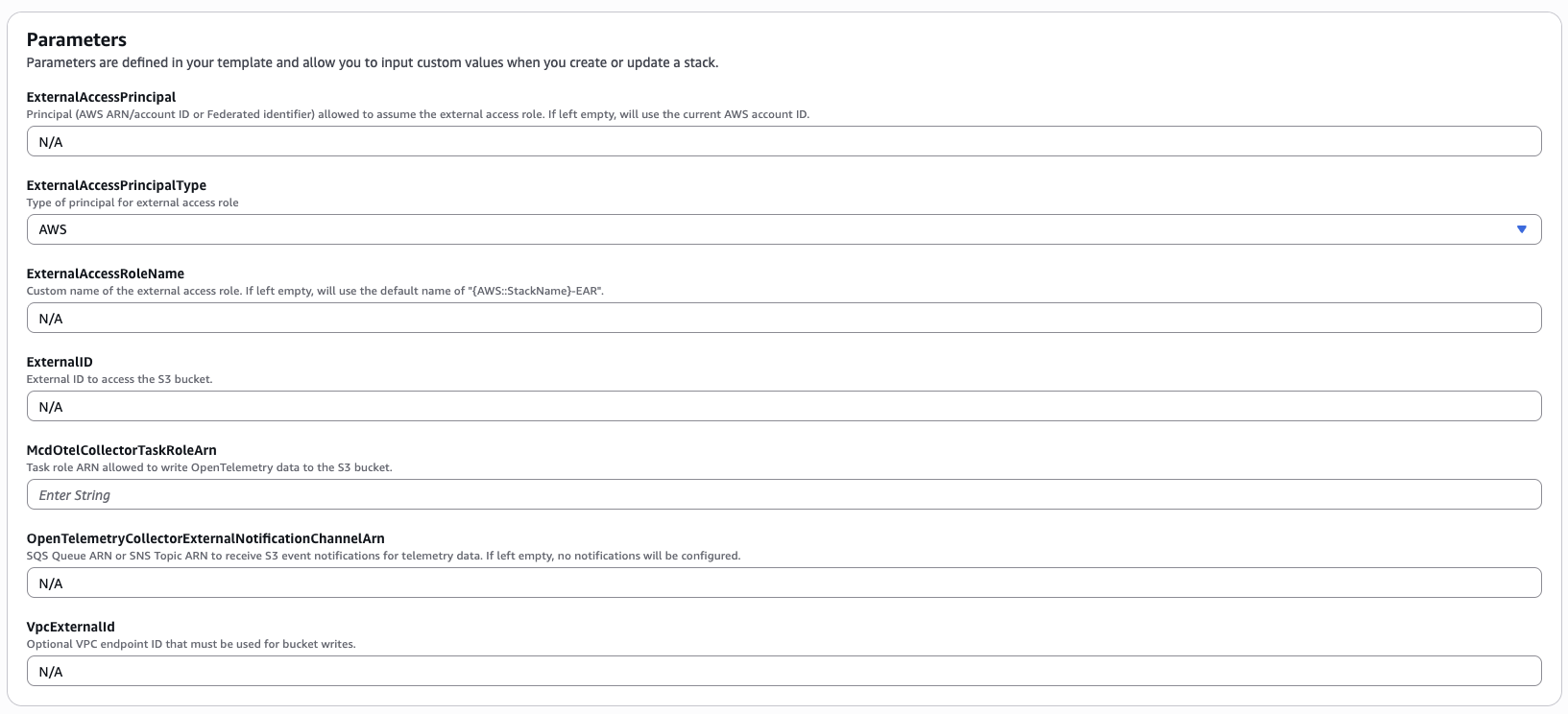
The following parameters can be ignored for now, they will be set in a later step as you configure trace ingestion into your data warehouse:
ExternalAccessPrincipalExternalAccessPrincipalTypeExternalAccessRoleNameExternalIDOpenTelemetryCollectorExternalNotificationChannelArn
The remaining parameters can be completed as follows:
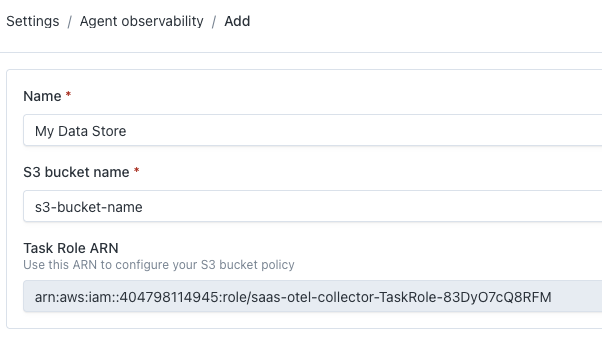
McdOtelCollectorTaskRoleArn - The Monte Carlo-hosted collector requires IAM policy permissions to write telemetry data to your S3 bucket. This parameter is used as the Principal for these permissions. The value needs to be retrieved from the Monte Carlo UI. Login to Monte Carlo and navigate to Settings -> Agent observability. Under "Trace data stores", click "Add" and copy the value of "Task Role ARN". See the screenshot below for reference.
2. Register the Data Store
After deploying the data store, you need to register it via the Monte Carlo UI. Login to Monte Carlo and navigate to Settings -> Agent observability. Under "Trace data stores", click "Add".
Complete the form as follows:
- Name: This is the name of the data store within Monte Carlo. Enter any value.
- S3 bucket name: Enter the name of the S3 bucket that was created by the CloudFormation stack.
Then click "Add". When the data store is successfully registered, the UI will show a "Key ID" and "Key Secret".
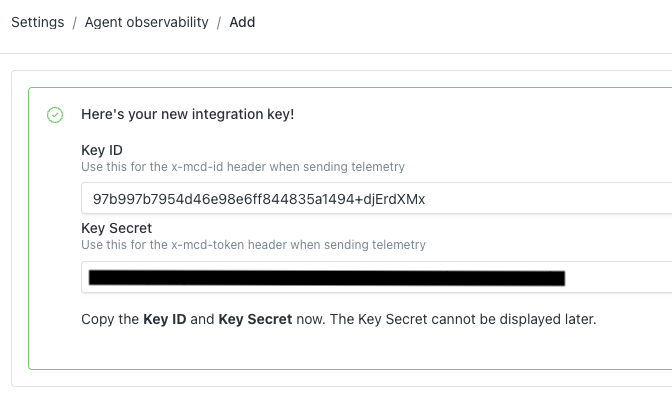
Copy and store these values as this is the only time the secret will be displayed. They will be used in the next steps.
3. Configure your Data Warehouse Ingestion Pipeline
Prerequisite: Data Warehouse S3 Access Configuration
Before continuing, your data warehouse must be configured to access the AWS S3 bucket containing the OpenTelemetry trace data. If your data warehouse is not currently configured to access the S3 bucket, refer to the guides below for Monte Carlo's recommendation on how to configure S3 access in your data warehouse.
Warehouse Vendor Guide Snowflake Configure Snowflake Storage Integration and Stage Databricks Configure Databricks External Location Athena N/A
Next, we need to configure your data ingestion pipeline to write the OpenTelemetry trace data from S3 to your data warehouse so it can be monitored by Monte Carlo. Follow the guide relevant to your data warehouse vendor for steps on how to configure this pipeline.
| Warehouse Vendor | Guide |
|---|---|
| Snowflake | Configure Snowflake Snowpipe |
| Databricks | Configure Databricks Delta Live Table |
| Athena | Configure Glue Crawler |
4. Configure your AI Agent
The final step is to configure your AI agent to begin sending traces to the OpenTelemetry Collector.
- Add the Monte Carlo OpenTelemetry SDK to your AI agent's source code.
- Provide the following URL to the Monte Carlo OpenTelemetry SDK's
otlp_endpointparameter:https://integrations.getmontecarlo.com/otel/v1/traces. If you instead configure the endpoint through the standardOTEL_EXPORTER_OTLP_ENDPOINTenvironment variable, use the base URLhttps://integrations.getmontecarlo.com/otel— the OpenTelemetry exporter appends/v1/tracesto that variable automatically. - Use the Key ID and Key Secret from Step #2 to configure the MonteCarlo API credentials. To do this, follow the instructions under "Add MonteCarlo API credentials as environment variables" in the SDK documentation.
- Follow the Monte Carlo OpenTelemetry SDK library's instructions to configure instrumentation.
You can now validate the deployment is working as expected by observing files being written to the S3 bucket and data being ingested into the relevant table in your warehouse.
You can begin creating Agent Monitors in Monte Carlo following the instructions here.
Updated 3 months ago